
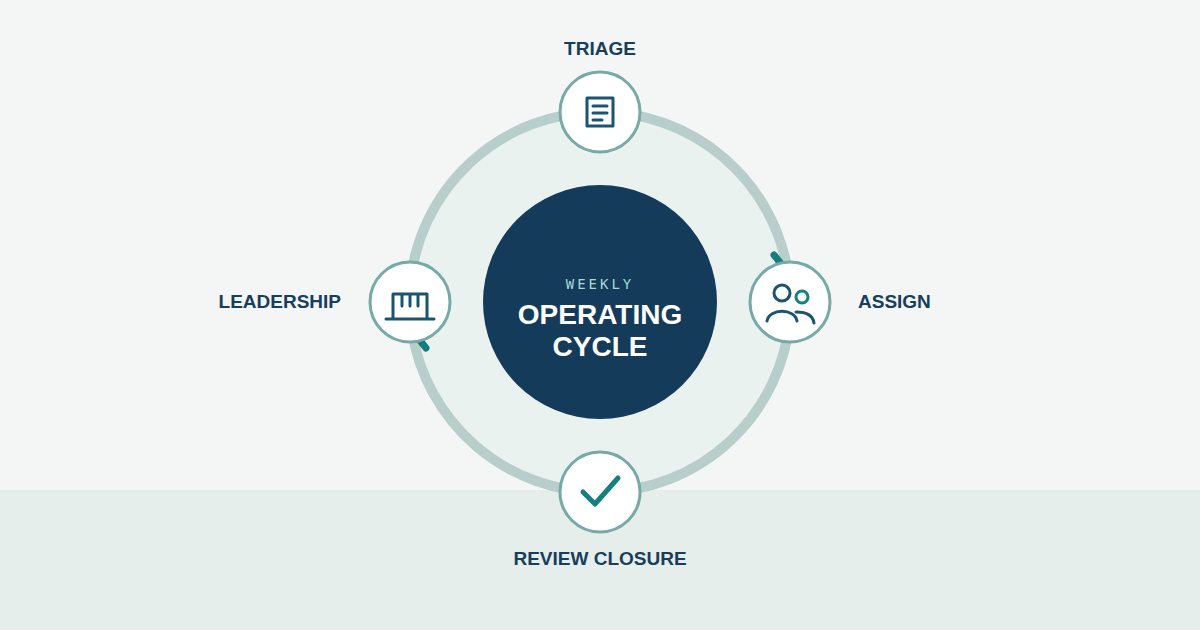
Salesforce data quality has no durable owner when every team can report a problem but no one is accountable for closing it. RevOps can make ownership explicit with a short weekly operating cycle: triage, assignment, closure review, and leadership decisions. The goal is not another abstract quality program. It is a queue in which every material issue has a decision-maker, a next action, and evidence of completion.
Market perspective
The public abstract and capability headings for Gartner’s Critical Capabilities for Augmented Data Quality Solutions cover profiling and monitoring, matching, issue workflow and corrective-action support. They describe technical capabilities for detecting and addressing data problems, not a weekly Salesforce operating calendar. Forrester’s public summary of The Data Governance RACI Matrix adds an organizational dimension: business, data, technology and risk stakeholders coordinate decisions about ownership, quality, access and reuse, with explicit responsibility and accountability. Together, these public descriptions provide context for the distinction between a control that identifies a problem and the people who decide what should happen next. Neither summary prescribes PDI’s cadence or evaluates ForecastGuard.
PDI perspective: PDI recommends pairing technical data-quality controls with the weekly RevOps ownership table below. Assign the issue, approve the least-risk change and require closure evidence. Monday-to-Friday sequencing is a practical PDI recommendation, not a Salesforce, Gartner or Forrester requirement. Product context: ForecastGuard · Salesforce.
These summaries use publicly available research or abstracts. Citations do not imply endorsement of PDI or its offerings.
The PDI weekly RevOps operating table
PDI operating recommendation: this Monday-to-Friday rhythm is our proposed model for recurring ownership and closure, not a Salesforce requirement. Combine days or adjust the cadence to your release windows and decision load. The deliverable is an accountable decision and verified result, not five extra meetings.
External product context: Salesforce Help describes native matching and duplicate rules for identifying potential duplicates and configuring actions such as alerts or blocks. That documentation supports the native duplicate-management context only; it does not prescribe this weekly cadence, validate ForecastGuard outcomes or cover every business data-quality issue.
| Cadence | Owner | Question | Output | Closure criteria |
|---|---|---|---|---|
| Monday: measurement | RevOps analyst with Salesforce admin support. | What changed in the agreed objects, fields and exception queue? | Dated measurement snapshot, denominator, rule versions and coverage limits. | Snapshot is reproducible; missing inputs are explicitly identified. |
| Tuesday: business-impact triage | Sales operations lead and affected business owner. | Which issues can change a forecast or near-term operating decision? | Prioritized queue with impact, accountable owner and target decision date. | Every priority item has an owner and an agreed decision need; duplicates in the queue are linked. |
| Wednesday: remediation approval | Data owner; admin or security/change approver as applicable. | What is the least-risk authorized correction? | Approved remediation scope, rollback/exception plan and verification criteria. | Authorization precedes execution; disputed items remain open, not silently corrected. |
| Thursday: execution and verification | Authorized Salesforce operator; designated verifier. | Did the approved change fix the observed condition without unintended effects? | Change reference plus before/after evidence and a scoped recheck. | Verification criteria are met, or a residual issue/failed check is explicitly reopened. |
| Friday: leadership review | RevOps leader with accountable business owners. | What recurring blockers require authority, capacity or a process change? | Short decision brief, unresolved risks and next-cycle commitments. | Decisions and owners are recorded; carryover is visible and no item closes merely to improve a metric. |
Define what enters the weekly queue
Start with a narrow set of issues that affect a current operating decision: opportunity ownership disputes, missing or stale close dates, conflicting stage updates, account or contact links blocking a handoff, and records whose fields disagree across connected processes. Keep the queue limited to items someone can act on. A broad list of every possible field defect quickly becomes a report no one reads.
Use a consistent issue record: Salesforce object and record link, field or relationship at issue, observed condition, business impact, detecting process, first-seen date, and an issue category. Avoid pasting unnecessary customer information into meeting notes. Put the detail where authorized operators already work.
Make the intake actionable
A useful item names the affected record set, business consequence, proposed owner, decision needed, next action, and closure evidence. If ownership is disputed, assign the ownership decision itself rather than circulating an unassigned issue for another week.
Triage by decision urgency and ownership
The weekly meeting should decide whether each issue is valid, who owns the next move, and when a decision is due. RevOps facilitates; it does not automatically own every correction. A sales manager may own a judgment about deal status, an account team may resolve a relationship, and a Salesforce administrator may own a configuration defect. Assign a single accountable closer even if several people contribute.
Use practical priorities tied to the operating calendar: whether a record blocks a forecast review, a customer handoff, or a required management decision. If the evidence is incomplete, assign a fact-finding action rather than debating assumptions in the room.
- Confirm the issue and its business consequence.
- Name one accountable owner and any supporting roles.
- Set a specific next action, due point, and closure evidence.
Make assignment part of the workflow
Send each owner a concise work item that points to the Salesforce record and states the question they must resolve. “Fix data quality” is not an assignment. “Confirm whether this opportunity remains in commit and update the stage rationale before Thursday’s review” is. Distinguish a correction request from a policy decision or system defect so work reaches the appropriate role.
For disputed ownership, define the escalation path before the dispute appears. The first owner can provide context; the manager or designated leader makes the tie-breaking decision. Record the decision in a durable place connected to the record or issue, rather than leaving it in meeting chat.
Use closure evidence, not a green checkbox
At the next session, close only when the promised outcome can be observed. Evidence could be a corrected value with its reason, a recorded manager decision, a completed configuration change reference, or a documented exception with owner and review date. A task marked done without a changed record or decision should return to the queue.
Keep status terms simple and consistent: new, triaged, assigned, blocked, ready for review, closed, or exception. “Closed” means the issue’s intended business outcome was checked, not that someone stopped working on it. Reopen an item if later evidence shows the condition returned.
Run the weekly review in four moves
A 30-minute session can work when the queue is prepared and decision rights are clear. The facilitator brings the open items, changes since the previous review, and items past their due point. Keep record-level investigation out of the meeting unless a decision genuinely requires the group.
- Triage new issues and reject duplicates or out-of-scope reports with a reason.
- Assign an accountable closer, action, and due point for accepted work.
- Review proposed closures against the expected evidence; reopen gaps.
- Escalate unresolved policy conflicts, capacity constraints, and recurring causes.
Give leaders a short decision brief
Leadership review should focus on patterns that need authority or capacity: repeat blockers, overloaded owner groups, conflicting definitions, unresolved exceptions, or a process that produces the same issue every week. Summarize counts only when the denominator and scope are clear. A raw increase in reported items may reflect better detection rather than deteriorating data.
Ask leaders for a specific decision: clarify who can approve a stage exception, allocate time for a system fix, or settle a cross-team ownership rule. Record the decision, named sponsor, and follow-up date in the issue process. A dashboard that does not prompt an action is not a leadership control.
Improve the cadence without turning it into a program
After several cycles, review a small set of operating signals: open items by age and owner, items returned after closure, overdue decisions, and recurring issue categories. Interpret them in context. Do not turn a single week’s count into a performance ranking for individual sellers or teams.
A lightweight charter helps the cadence survive staff changes: purpose, scope, issue definitions, decision rights, meeting owner, escalation path, and evidence standard. PDI’s ForecastGuard material and related Salesforce articles can help teams frame the conversation around forecast-facing work, but the operating model should remain grounded in the organization’s own sales process. Sustainable ownership comes from named roles and verifiable closure, not from a new committee.
Sources
- ForecastGuard for Salesforce
- Salesforce forecast accuracy software
- ClaudeForce Salesforce data quality
- External native-platform context: Salesforce Help — Manage Duplicate Leads and Contacts in Salesforce
- Gartner — Critical Capabilities for Augmented Data Quality Solutions (public abstract)
- Forrester — The Data Governance RACI Matrix (original client report; login required)
- Forrester — The Data Governance RACI Matrix (public summary)