
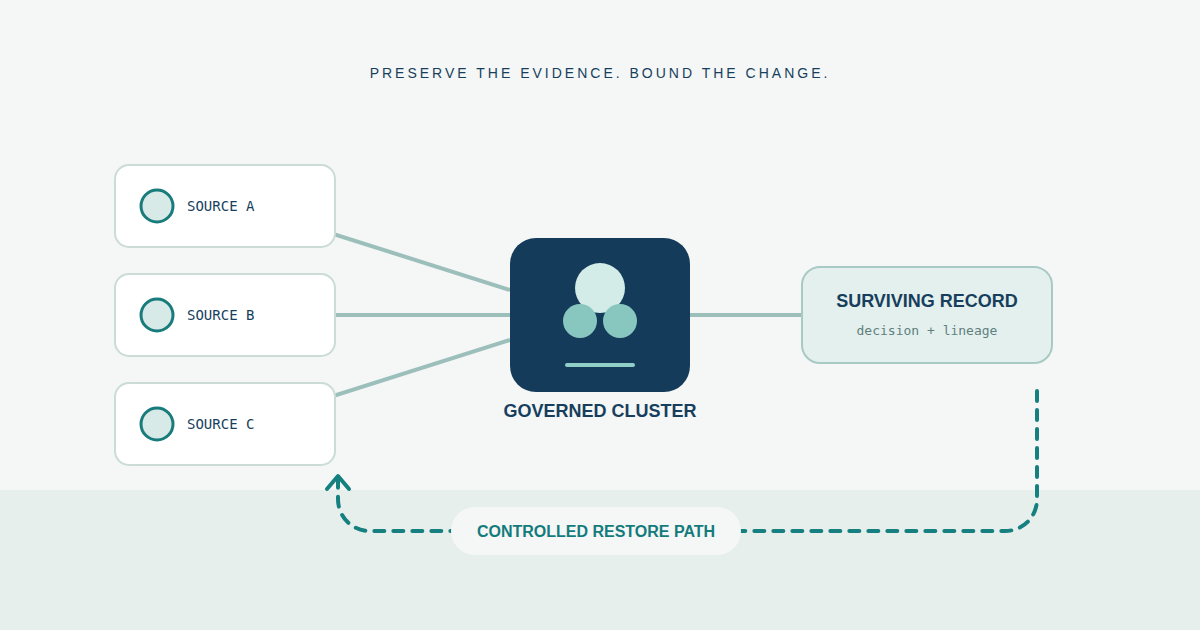
Identity resolution is not simply deciding that two rows look similar. It is a governed sequence of evidence, decision, survivorship, and change. If a mistaken merge cannot be explained and corrected, the cost of matching uncertainty spreads into customer service, reporting, and downstream systems. Reversibility begins with careful boundaries: preserve what the engine can undo, and never imply that every consumer of a merged record can be rolled back automatically.
Market perspective
Gartner’s public abstract for Critical Capabilities for Master Data Management Solutions places MDM in the context of demand for dependable data, including data used by AI. Its publicly listed capability categories include entity resolution and matching, data quality, stewardship and governance; consolidation appears among the implementation styles. That is a broader frame than a pairwise similarity score. The visible categories distinguish matching from other responsibilities involved in managing shared records and their use. They do not establish that every evaluated solution offers identical merge controls or rollback behavior. This article draws only on the public description and categories, not proprietary scores, rankings or vendor assessments.
PDI perspective: PDI recommends making the match decision explainable, setting survivorship explicitly and preserving history before approving a merge. Where Peregryn supports cluster-level rollback, retain the evidence needed to review and use it. Do not confuse restoration of a cluster with automatic reversal of changes in every downstream system. Product context: Peregryn · Identity resolution.
These summaries use publicly available research or abstracts. Citations do not imply endorsement of PDI or its offerings.
PDI worked example: a match decision that can be reconstructed
Illustrative fictional records only: SYN-A17 in a CRM says “Aster Machine Co.” and SYN-B42 in an ERP says “Aster Machine Company.” Both carry the synthetic business reference FICT-042. SYN-C63 has a similar name but a different reference. These are teaching records, not customer data, a benchmark or a claim that name similarity authorizes a merge.
PDI operating recommendation: retain each stage below separately, so a proposed match is never confused with approved survivorship or permission to overwrite a downstream application. The example is a governance design, not a claim that Peregryn ships these exact ticket labels or a particular interface.
External technique context: AWS Entity Resolution documents rule-based and machine-learning-based matching workflows. This establishes that these are existing matching approaches; it is not evidence of Peregryn’s implementation, survivorship or rollback. The linked PDI Peregryn product material is the basis for the narrower claims of explicit survivorship and full cluster-level rollback.
| Stage | Illustrative record or decision | Evidence and boundary |
|---|---|---|
| Candidate generation | SYN-A17 and SYN-B42 enter a candidate set on the shared synthetic reference; SYN-C63 is held separately. | Retain source IDs and candidate-generation rule version. A candidate is not a match approval. |
| Match decision | A reviewer confirms the reference and approved corroborating attributes for A17/B42; C63 remains unresolved. | Record the rule/scoring evidence, reviewer role and rationale; no fabricated confidence percentage or automatic approval is implied. |
| Survivorship | An approved field rule prefers the CRM display name and ERP billing status. | Retain source values and the winning-value rationale. “Newest wins” is not an unstated default. |
| Cluster/merge | Approval SYN-M08 permits cluster SYN-K12 to contain A17/B42 only. | Record membership and pre-merge state. Cluster membership does not itself authorize changes in other systems. |
| History | Decision, survivorship rule, approval and cluster versions remain linked to SYN-K12. | Preserve timestamps and change history sufficient to reconstruct what was decided. |
| Rollback | A later authoritative correction triggers approved restoration of the pre-merge cluster state. | Verify restored membership and values. Reconcile downstream changes separately: cluster rollback is not automatic undo of every external write. |
Keep deterministic and probabilistic evidence distinct
Deterministic matching applies explicit rules: an exact trusted identifier, a defined combination of attributes, or another condition the business has approved. Probabilistic matching scores similarity across selected attributes, such as name, address, or contact details. These are different kinds of evidence. A high score is not the same as a uniquely identifying key, and a deterministic rule is only as trustworthy as its source and governance.
For each candidate pair, retain the attributes compared, normalization applied, rule or scoring model version, score or match reason, and the decision threshold in effect. Keep missing, conflicting, and low-quality attributes visible. Review a sample of accepted and rejected pairs with business owners before changing thresholds in production.
Separate candidate generation from merge approval
Candidate generation identifies records worth comparing; it should not silently authorize a destructive action. Define separate outcomes for no match, candidate for review, approved match, and merged cluster. A cautious operating posture may automatically merge only well-understood cases while routing ambiguous or high-impact groups to review.
Set thresholds and review requirements by data domain and consequence. Duplicate suppliers can affect payments and controls; customer identity may influence service history; account matching can change reporting. A single universal cutoff may conceal these differences. Record who approved the policy and how exceptions are handled.
Make survivorship rules explicit before combining values
When records are considered the same entity, survivorship determines which attribute values persist. Define the rule for each relevant field: trusted-source precedence, most recently verified value, completeness, or a human decision. Specify tie handling and what happens when sources conflict. Avoid relying on load order or an unexplained “best value” label.
Store enough lineage to show which input contributed each surviving value and why. That makes a golden record reviewable and helps stewards distinguish a valid identity link from a questionable attribute choice. A match can be correct while one field’s survivorship decision is wrong.
Retain cluster history as a governed record
A cluster should have a durable history of membership changes, merge and unmerge events, decision evidence, rule versions, operator or service identity, timestamps, and the resulting surviving attributes. Preserve prior membership and values in an access-controlled audit trail. This is necessary not only for rollback but also for explaining why a downstream report changed.
Before running at scale, test the lifecycle on representative records: two-record match, multi-record cluster, conflicting attributes, corrected source data, and an intentionally false match. Confirm who can approve, merge, unmerge, and review the history. Keep test evidence separate from production decisions.
Define rollback precisely
At the resolution-engine level, cluster rollback should restore the cluster’s pre-merge membership and state according to the engine’s documented behavior. Peregryn describes full rollback at the cluster level. That is a bounded claim: it concerns the engine’s own cluster operation and history.
It does not mean every downstream CRM, warehouse, integration, cache, export, or consumer automatically reverts. A merged identifier may already have propagated or triggered other actions. Map those dependencies, define compensating procedures, and test how a corrected cluster is communicated. Do not promise an automatic cross-system undo unless each integration has been designed and verified for it.
Cluster restoration is not downstream undo
An approved cluster rollback needs a separate assessment of exports, integrations, and decisions already made from the merged view. Record the parties responsible for downstream reconciliation and the evidence they will return; do not imply the engine can reverse every consuming system.
Operate reversibility with approvals and controls
Use role separation where the impact warrants it: the person reviewing evidence need not be the person authorizing a high-impact merge. Capture approval thresholds, emergency handling, retention of decision logs, and a process for reporting a suspected false merge. Protect the underlying personal or commercially sensitive attributes; rollback evidence should not become an uncontrolled data export.
A runbook should state how to pause new merges, identify affected clusters, assess downstream consumers, authorize an unmerge, validate restored membership, and notify owners. Include a clear distinction between reversal in the engine and repair in connected applications.
Prove the design before broad rollout
A useful pilot measures decision quality with reviewed examples, not a headline match count. Document the record population, source quality, rules, thresholds, reviewed pairs, false-match findings, unresolved cases, and rollback test. Expand only when owners agree that the decisions are understandable and the recovery path fits operational reality.
Peregryn’s product overview describes deterministic rules alongside probabilistic scoring, explicit survivorship, and cluster-level rollback. Its security page is the place to examine deployment and control details. Treat those capabilities as inputs to architecture review: validate how they fit your data, interfaces, authorizations, and downstream systems before relying on them in a production recovery plan.