
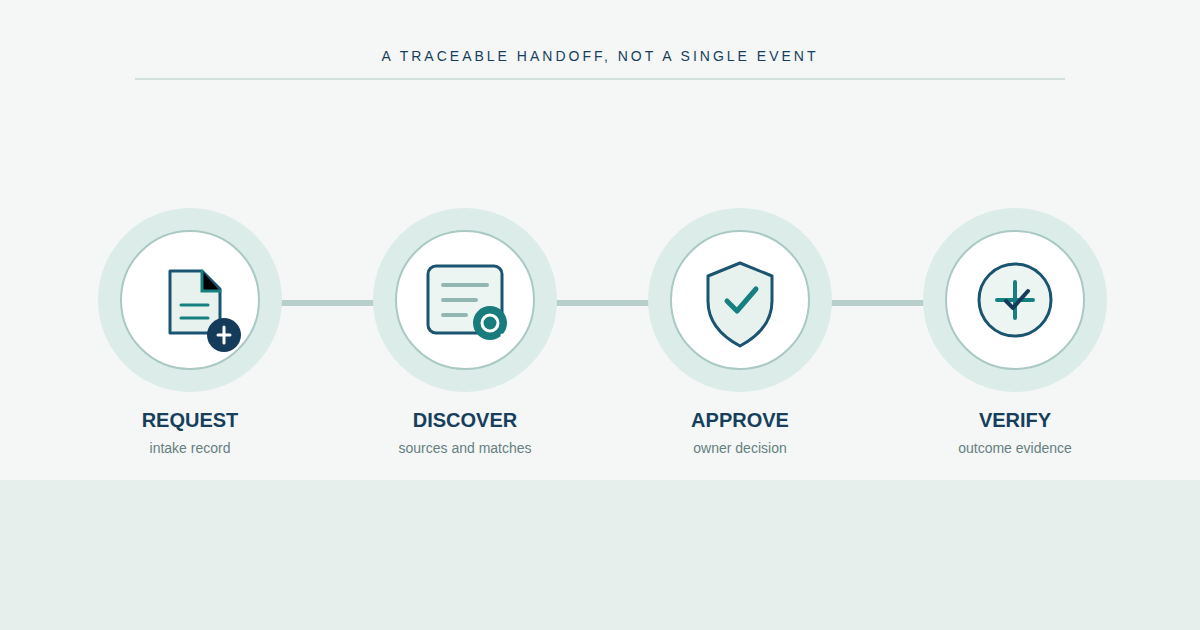
A consent record and an erasure request are not operational outcomes. Between a person’s instruction and a verified disposition sit identity resolution, data discovery, ownership, policy review, execution across systems, and evidence that the work completed. The chain matters because each handoff can lose context or leave an unverified assumption behind.
Market perspective
Deloitte India’s public discussion of the DPDP Rules 2025 presents implementation as a staged organizational effort rather than a single technology installation. Its roadmap connects initial data mapping and governance with later work on consent processes, logging, incident response, rights handling, retention and audit readiness. It also treats monitoring and governance refresh as continuing activities. These themes describe the breadth of implementation work; they do not replace the Act, Gazette notifications or an organization’s applicability analysis. This article uses Deloitte for that operational context only. Statutory timing and legal boundaries remain grounded in the primary MeitY/Gazette sources cited below, not the secondary article’s date graphics.
PDI perspective: PDI recommends operationalizing those responsibilities as one linked evidence chain: intake context, authorized scope, discovery, ownership, decision, approved action, verification, exceptions and retained evidence. The chain helps explain handoffs; it does not itself establish a lawful basis, authorize erasure or certify compliance. The legal-advice disclaimer and phased-timing distinctions below remain essential. Product context: Kestryl · DPDP compliance.
These summaries use publicly available research or abstracts. Citations do not imply endorsement of PDI or its offerings.
PDI DPDP Evidence Chain: one request, nine linked handoffs
This article is operational guidance, not legal advice or certification. Applicability, legal grounds, exemptions and retention duties require qualified review. A completed PDI evidence chain is not a finding that an organization complies with the DPDP Act or Rules.
Statutory and regulatory context: the DPDP Act 2023 is the legal source for the relevant notice, consent, processing and rights provisions. G.S.R. 843(E), dated 13 November 2025, phases commencement of the Act’s provisions. Rules 2025, G.S.R. 846(E), dated 13 November 2025, should be read with the official G.S.R. 892(E) corrigenda dated 10 December 2025. These primary texts, not the workflow below, determine legal obligations.
Phased timing: the Rules specify immediate commencement for rules 1, 2 and 17–21, one year for rule 4, and eighteen months for rules 3, 5–16, 22 and 23. The eighteen-month commencement date used here is 13 May 2027; the one-year stage is 13 November 2026. G.S.R. 843(E) separately identifies the corresponding Act provisions. Do not treat all provisions as having a single commencement date.
PDI operational recommendation: link request/notice or consent context → scope → discovery → owner → decision → approved action → verification → exception → retained evidence. The nine handoffs below are PDI’s evidence-management model, not a statutory form, mandated sequence, regulator-approved checklist or automatic erasure instruction.
| Handoff | Linked artifact | Decision or completion gate |
|---|---|---|
| Request/notice or consent context | Request ID, identity-review reference and applicable notice/consent or other processing context. | Confirm the request and context; do not assume every processing activity rests on consent. |
| Scope | Authorized identifiers, sources, copies, time window and exclusions. | Approve a bounded search without exposing unnecessary personal values. |
| Discovery | Run and ruleset references, findings and unassessed locations. | Separate observed matches from uncertain candidates. |
| Owner | Accountable business role and system/operator ownership. | Name who can decide and who can execute; they need not be the same role. |
| Decision | Applicability review, proposed disposition and rationale. | Record approval, refusal or deferral with the relevant legal/retention review where needed. |
| Approved action | Authorization reference and system-of-action ticket. | Execute only the approved scope through the authorized system or operator. |
| Verification | Method, timestamp, observed result and coverage limits. | Verify the outcome; an accepted ticket alone is not evidence of erasure. |
| Exception | Unresolved copy, retention constraint, refusal or access limitation with an owner. | Keep non-closure visible with a revisit condition rather than a false success. |
| Retained evidence | Access-controlled manifest linking the preceding artifacts and approved retention decision. | Retain proportionate evidence under an approved policy, not an indefinite duplicate of the person’s data. |
Separate the instruction from the decision
Start by recording the incoming event: its channel, received time, reference identifier, asserted identity attributes, and the wording or category of the request. Keep consent changes, withdrawal, correction, and erasure requests distinguishable; they may require different operational handling. Restrict access to the source material and minimize copies of identity data.
The intake record is not itself a legal conclusion. Route it to the organization’s designated privacy or legal process to determine what review is required, what information is needed to resolve identity, and which timelines or exceptions apply. This article is operational education, not legal advice; applicability and legal sufficiency must be assessed by qualified counsel for the relevant facts.
Keep one request reference across handoffs
Use a request reference to connect intake, identity review, discovery results, approval, execution tickets, verification, and exceptions. A reference makes the chain traceable; it does not authorize an action or establish the request’s legal validity.
Resolve the person and discover where data may reside
Use approved identifiers and matching procedures to create a bounded search context. Names, email addresses, account identifiers, and historical aliases may point to different records, but a match should retain the evidence and confidence behind it. Avoid treating a weak match as authorization to delete a record that may belong to someone else.
Run discovery against the approved systems and document coverage: source, owner, data location, scan time, method, result, and limitations. Include operational stores, analytics copies, exports, and vendor-managed locations where the organization’s inventory and agreements indicate they may be relevant. A missed source is not a verified negative.
Assign ownership before asking for action
For each candidate record or system, identify an accountable data or application owner and the operator who can perform the change. Confirm record identity, purpose, dependencies, retention context, and any preservation or exception review required by internal policy. The owner should record a decision and rationale, not merely acknowledge an email.
A useful handoff carries a stable request ID, source path, matched-record evidence, requested disposition, approval state, and the evidence expected back. Keep data minimization in view: an operator should receive enough information to find the correct record, not an unrestricted bundle of personal details.
Keep execution in the system of action
Discovery and governance tooling can help identify records, route work, and preserve decisions. The actual erasure or change is performed by the system and process authorized to act on that data: for example, an application’s supported deletion workflow, a platform operator, or a vendor process. The work queue should link to that system’s change or case reference and record who initiated the action.
Do not claim that a discovery product itself executes erasure unless the relevant system integration and action are explicitly established. For every system, define the expected completion signal, what a successful response means, and how retries or partial failures are handled. A returned “accepted” response is not necessarily proof that all copies are gone.
Verify outcomes across systems and copies
Verification should be designed per system. It may involve a deletion status, a controlled follow-up query, a tombstone or suppression record, a downstream propagation check, or an operator attestation with supporting evidence. Choose a method that demonstrates the intended result without creating another unnecessary copy of the personal data.
Record verification time, method, actor or service identity, outcome, and any residual state that the method cannot test. Where backups, immutable records, legal holds, or derived datasets are handled differently, describe that distinction and route it through the approved policy. Do not turn a system’s limitation into an unqualified “erased everywhere” statement.
Make exceptions visible and time-bound
A system may be unavailable, the identity match may be uncertain, or a record may need a separate retention review. Track each exception with its affected source, reason, decision owner, approval reference, compensating measure where applicable, next action, and review date. Partial completion should remain partial in the status model.
A useful exception queue is ordered by next decision or action, not just age. It should surface blocked approvals, failed execution, ambiguous matches, unverified outcomes, and partner dependencies distinctly so that escalation reaches the team able to resolve the specific obstacle.
Preserve a linked, reviewable evidence chain
The final record should connect intake, discovery, identity decision, ownership, authorization, execution reference, verification, and exceptions under one request identifier. Keep original observations distinct from later decisions, capture timestamps and responsible roles, and store sensitive attachments under the organization’s approved access and retention controls.
For organizations working from PDI’s DPDP materials, the checklist page identifies the official source basis: the DPDP Act 2023, commencement notification G.S.R. 843(E), and DPDP Rules 2025 notification G.S.R. 846(E), both notifications dated 13 November 2025. The eighteen-month commencement date is 13 May 2027; commencement is staged, so this is not a claim that every provision begins on that date. Consult the official texts and qualified counsel for applicability to the relevant facts. The related DPDP enterprise data-control guide and Kestryl DPDP cockpit provide context for discovery and evidence workflows, but neither replaces legal review or the external systems that carry out approved actions.
Sources
- DPDP compliance: enterprise data control
- DPDP compliance checklist and official source basis
- Kestryl DPDP cockpit
- Primary law: DPDP Act 2023, Act 22 of 2023 — official Gazette text hosted by MeitY
- Primary commencement notification: G.S.R. 843(E), 13 November 2025
- Primary Rules: DPDP Rules 2025, G.S.R. 846(E), 13 November 2025
- Primary Rules corrigenda: G.S.R. 892(E), 10 December 2025
- Deloitte India — India’s DPDP Rules 2025: Leading digital privacy compliance