
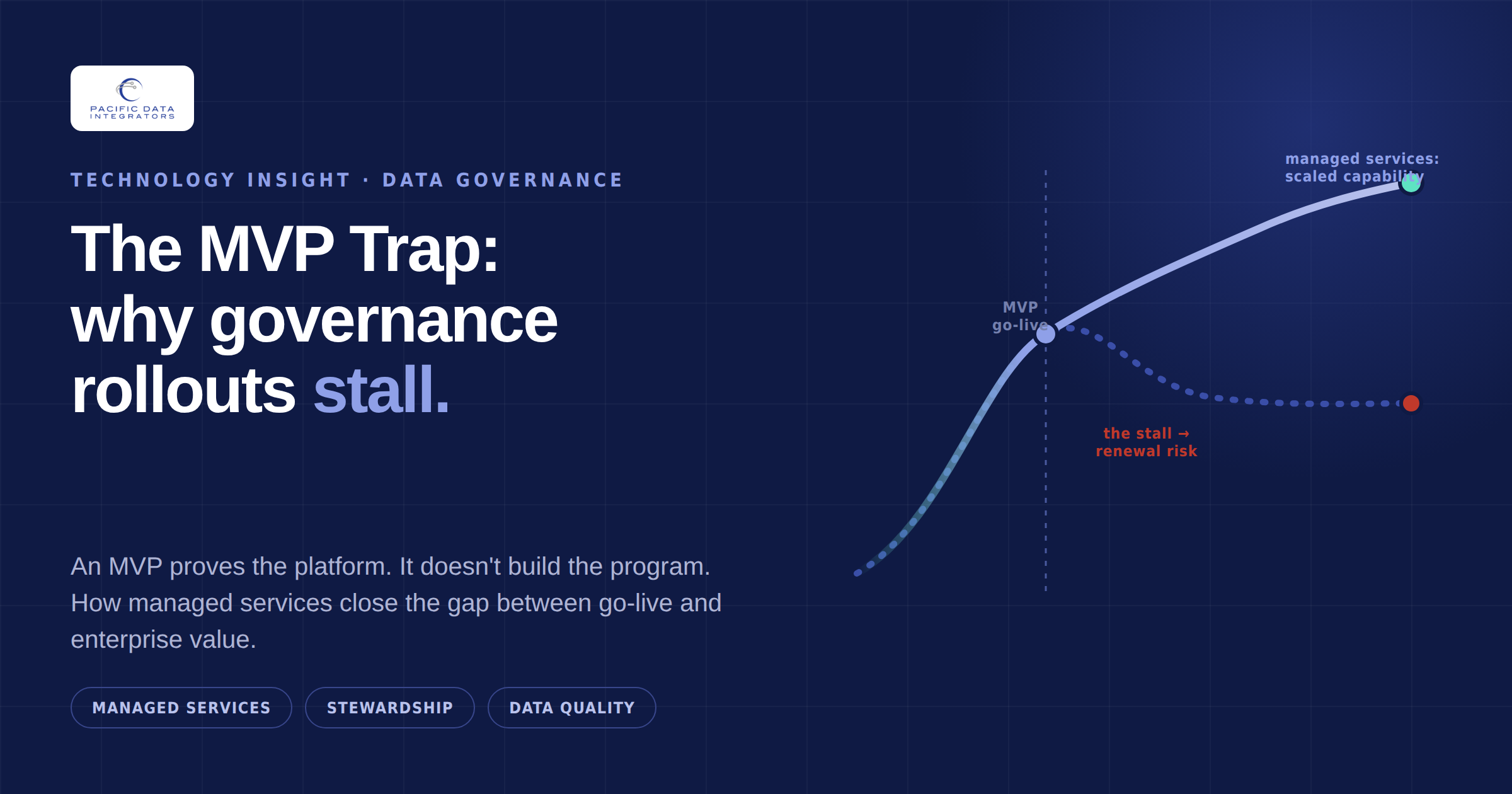
There is a moment I have seen play out at organization after organization. The data governance platform has been selected, the contract is signed, and a minimum viable product is stood up in a few months. A catalog is populated, a business glossary has its first few dozen terms, a handful of data quality rules are running, and the steering committee sees a polished demo. Everyone agrees it's a success.
Then, twelve to eighteen months later, the renewal conversation arrives, and someone asks a hard question: what has this actually changed for the business?
Too often, the honest answer is "not as much as we hoped." The catalog is stale. The glossary hasn't grown. Stewards were named but never really started stewarding. The data quality dashboards exist, but nobody owns the follow-up when a score drops. The software works exactly as designed. The program never became real.
That question is where a stalled program becomes a renewal risk. And it isn't a technology failure. It is a predictable outcome of treating data governance as a software implementation with an MVP finish line, rather than as an ongoing enterprise capability that has to be operated, staffed, and scaled.
Key takeaway
Data governance programs often stall after an MVP because the MVP validates the platform but does not create the operating model, capacity, stewardship cadence, quality operations, domain onboarding, and value reporting required at enterprise scale. Managed services close this gap by providing sustained operational support while keeping business ownership and decision rights inside the organization.
An MVP proves the tool. It doesn't build the program.
An MVP is designed to answer a narrow question: can this platform do what we need in our environment? It connects to a few sources, demonstrates lineage and profiling, and shows a workflow or two. That is valuable, and it's the right way to de-risk a purchase.
But an enterprise rollout asks different questions. Who owns this data domain, and do they have the authority to make decisions about it? What happens when two business units define "active customer" differently? How does a new data source get onboarded, and who approves it? When a quality rule fails, whose job is it to fix the root cause? How do we bring the fifth, tenth, and twentieth domain online without reinventing the approach every time?
None of those questions are answered by configuring software. They are answered by an operating model, and by people with the time to run it, week after week.
Why the gap happens
Budgets favor licenses over capability.
Software is a tangible line item. Services to operationalize and scale are harder to justify, so they get trimmed to "just enough to get us live."
The internal team is stretched thin.
The people expected to carry governance forward after the MVP usually have full-time day jobs. Governance becomes the thing they get to on Friday afternoons, and momentum fades.
Vendor support is built for product adoption, not organizational change.
Customer success teams are genuinely helpful at driving feature usage, but they aren't positioned to run stewardship operations, facilitate a data council, or onboard new business domains on the customer's behalf.
"We'll take it from here" is said too early.
Knowledge transfer at the end of an MVP typically covers how to use the tool, not how to run the program: the cadences, escalation paths, metrics, and playbooks for onboarding the next domain.
How a stalled program becomes a churn risk
Renewals are value decisions. When governance never scales beyond its MVP footprint, the value story at renewal time is thin, and the warning signs appear well before the contract date.
Active usage concentrates in a small core team. The executive sponsor who championed the purchase moves on, and their successor inherits a line item without a narrative behind it. Finance starts asking what the organization is getting for the spend. Someone suggests consolidating onto a tool already bundled in the cloud or analytics stack.
From there, scope and seats get cut, expansion is shelved, or the platform is replaced outright, and the organization starts a new selection and a new MVP, very often hitting the same gap again. Switching tools rarely fixes the problem, because the tool was never what was missing.
The cost goes well beyond sunk license fees. The organization loses a year or two of momentum, its internal champions lose credibility, and leadership may conclude that "governance doesn't work here," right when trusted data matters most for AI and analytics initiatives. For software vendors and their partners, it shows up as churn on accounts that looked healthy at go-live.
Why another project isn't the answer either
The instinctive fix is to buy a second services project: a rollout phase with a statement of work, a timeline, and an end date. That helps, but it often just moves the cliff. When the project ends, the same stretched internal team inherits a larger footprint to maintain.
Data governance isn't a project with a finish line. Catalogs need continuous curation. Quality rules need monitoring and triage. New systems, reorganizations, and regulatory changes arrive constantly. Stewards turn over. The work is operational by nature, which means it needs an operational support model.
How managed services close the gap
A managed services model gives the organization sustained, expert capacity to run and scale governance, without having to hire a full team up front or rely on part-time effort. In practice, a well-designed data governance managed service typically covers several areas.
Platform operations.
Administration, upgrades, connector maintenance, performance tuning, and user access management, so the platform stays healthy and the internal team isn't pulled into keeping the lights on.
Scaled domain onboarding.
A repeatable, predictable cadence for bringing new business domains online: identifying owners and stewards, harvesting and curating metadata, establishing critical terms, and implementing priority quality rules. Instead of expansion stalling after the MVP, the footprint grows on a planned roadmap.
Stewardship and data quality operations.
Monitoring quality scorecards, triaging failed rules, routing issues to the right owners, and tracking them to resolution. Stewards get backup and coaching rather than being left alone with a queue.
Program operations.
Supporting the governance council and working group cadence: preparing agendas, tracking decisions, maintaining policies and standards, and keeping the operating model alive through leadership and staff changes.
Adoption and value reporting.
Regular reporting on what matters to executives: domains governed, active users, issues resolved, time saved finding trusted data, and improvements in downstream reporting. This builds the value narrative continuously, so there's a clear story long before renewal.
Capability transfer.
A good managed service is designed to make the customer stronger over time, coaching internal teams so ownership of decisions stays in the business, and letting the provider's role shift toward operations and advisory support as maturity grows.
Why the model fits the problem
Managed services address the root causes of the MVP gap directly.
It solves the capacity problem, giving the program dedicated hands without asking business staff to govern data in the margins of their calendars. It provides continuity, so the program survives sponsor changes, staff turnover, and competing priorities. It offers predictable cost, typically a steady operating expense that's easier to budget and defend than a series of one-off projects. It's elastic, scaling up during major rollouts or regulatory pushes and down during steady state. And when service levels are tied to adoption and outcomes rather than hours, it aligns incentives around the thing that actually drives renewal: realized value.
What to look for in a managed services partner
Not every managed service is built for governance. Look for a partner with deep hands-on experience on your specific platform, and just as importantly, experience designing and running governance operating models. Ask how they onboard new domains and how long it typically takes. Ask what they report on and how often. Ask how they measure success, and whether their service levels reflect business outcomes or just ticket counts. And ask how they plan to build your internal capability over time rather than create permanent dependency.
A question worth asking before you sign, or right after your MVP
If you're evaluating a data governance platform, or you've recently completed an MVP, put this question in front of your leadership team:
Who will operate and scale this program across the enterprise over the next three years, and do they have the time, skills, and support to do it?
If the answer is uncertain, don't delay the investment. Plan for the full lifecycle now, while budgets, sponsorship, and enthusiasm are at their highest, and consider a managed services model as the bridge from MVP to an enterprise capability.
The software is the foundation. The program is what delivers the value, and value is what gets renewed. Organizations that pair their platform with sustained operational support are the ones expanding their governance footprint at renewal time, instead of defending it or starting over.
Data governance managed services FAQs
What is the data governance MVP trap?
The data governance MVP trap is treating governance as a software implementation with an MVP finish line. An MVP proves the platform, but it does not create the operating model, capacity, stewardship cadence, or quality operations needed to run and scale the program.
Why do data governance programs stall after implementation?
Programs stall when services are trimmed to get live, internal teams are stretched thin, vendor support focuses on product adoption, and knowledge transfer covers tool use instead of the cadences, escalation paths, metrics, and playbooks needed to run the program.
How do managed services support data governance?
Data governance managed services provide sustained expert capacity for platform operations, domain onboarding, stewardship and data quality operations, program operations, adoption and value reporting, and capability transfer.
What should organizations look for in a data governance managed services partner?
Look for hands-on experience with the specific platform, experience designing and running governance operating models, a repeatable domain-onboarding approach, reporting tied to adoption and outcomes, and a plan to build internal capability rather than create permanent dependency.